FDM vs Resin 3D Printer: Which Should You Buy?
FDM vs Resin 3D Printer: Which Should You Buy?
When you start researching 3D printers, you quickly run into two completely different technologies: FDM and resin. They both call themselves "3D printers" but produce objects in fundamentally different ways, suit different use cases, and require very different workflows.
Most beginners should start with FDM. But the right answer genuinely depends on what you want to print — so here's an honest breakdown of both.
What Is FDM Printing?
FDM (Fused Deposition Modeling) is what most people picture when they think of a 3D printer. A spool of plastic filament is fed into a heated nozzle that melts it and deposits it layer by layer onto a build plate. The part is built from the bottom up, one layer at a time.
Common FDM filaments: PLA, PETG, ABS, ASA, TPU, Nylon, Polycarbonate
Typical layer height: 0.1–0.3mm
FDM printers range from $169 (Creality Ender 3 V3 SE) to $1,899+ (Bambu Lab H2D) and cover everything from bedroom hobbyist use to small-scale production.
What Is Resin Printing?
Resin printers (MSLA, SLA, DLP) work by curing liquid photopolymer resin with UV light. The build plate lifts up from a vat of liquid resin, curing one thin layer at a time with each exposure.
Typical layer height: 0.02–0.05mm — roughly 5× finer than FDM
Common resins: Standard, ABS-like, water-washable, castable, flexible
Resin printers typically cost $150–500 for the machine, but the consumables (resin, FEP film, gloves, wash and cure station) add ongoing cost.
The Key Differences
Detail and Surface Quality
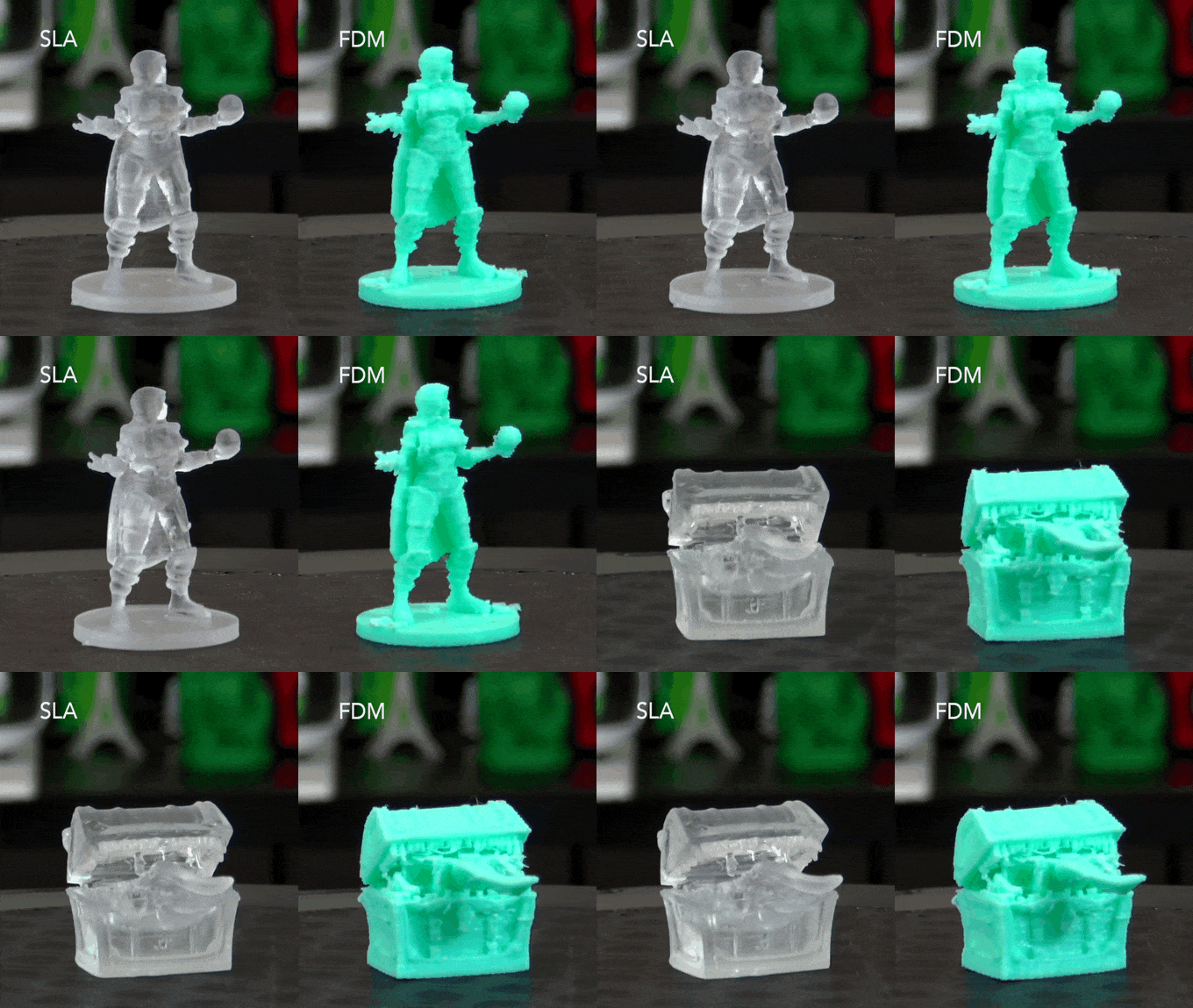
This is where resin wins decisively. Resin printers produce smoother surfaces and sharper fine detail than FDM can achieve. If you're printing miniatures for tabletop games, jewellery masters, dental models, or anything with intricate surface texture — resin is the right tool.
FDM prints have visible layer lines at normal settings. At fine settings (0.1mm layers) quality is respectable but still can't match resin for intricate detail.
Build Volume
FDM wins here. Most FDM printers offer build volumes of 220×220×250mm or larger. The Bambu Lab A1 Mini — one of the most compact modern FDM printers — offers 180×180×180mm. High-end FDM machines like the Bambu Lab H2D reach 350×320×325mm.
Resin printers typically offer much smaller build plates (130×80mm is common on budget machines) because UV curing struggles to maintain consistency across large areas.
If you want to print functional parts, cosplay armour, props, or anything large — FDM is the only practical choice.
Materials and Durability
FDM filaments vary enormously. PLA is easy and biodegradable. PETG is tougher and slightly flexible. ABS and ASA handle heat and UV outdoors. Nylon, Polycarbonate, and carbon-fibre composites are proper engineering materials used in professional applications.
Resin parts are generally more brittle than equivalent FDM prints. Engineering resins exist but are significantly more expensive. Standard resins are unsuitable for load-bearing, high-impact, or outdoor use.
Mess and Post-Processing
FDM is clean. Remove the print from the plate, clip off supports if needed, and you're done. No chemicals, no washing, no UV curing.
Resin requires more work:
- Uncured resin is a skin irritant — you need nitrile gloves and good ventilation
- Prints must be washed in isopropyl alcohol (IPA) or water (water-washable resin)
- Prints then need UV curing in a curing station
- Waste resin and IPA must be disposed of carefully
This isn't a dealbreaker, but it significantly changes the workflow and adds recurring cost.
Print Speed
Modern FDM printers are fast. Machines like the Bambu Lab A1 Mini print at 500mm/s and can produce a small object in under 30 minutes. The gap between FDM and resin on speed has narrowed as MSLA resin printers now cure entire layers simultaneously — but for most practical objects, FDM is faster end-to-end once you account for post-processing.
Smell and Safety
FDM with PLA has minimal odour. ABS and some other filaments smell more strongly and benefit from ventilation. Generally safe in a home environment.
Resin smells strongly and contains chemicals that are harmful with prolonged skin contact or inhalation. Resin printing in a shared living space — bedroom, kitchen, open-plan home — requires proper ventilation. Many people dedicate a garage or utility room to resin printing.
Which Should You Buy?
Choose FDM if you:
- Are a complete beginner
- Want to print functional parts, household items, tools, or cosplay props
- Need a large build volume
- Want a clean, low-hassle workflow
- Plan to print in a shared living space
- Have a budget of $169–$800 for a capable all-around machine
Choose Resin if you:
- Want extremely fine detail — miniatures, jewellery, dental, figurines
- Are comfortable with chemical handling and ventilation requirements
- Have a dedicated space for the printer
- Don't need large prints
Still unsure?
The vast majority of beginners will be happier starting with FDM. The workflow is simpler, the materials are safer and more versatile, and modern FDM printers produce excellent results for almost everything hobbyists want to make.
Our site covers FDM printers in depth. Take our printer quiz to get a personalised FDM recommendation matched to your budget, experience level, and what you want to print.
FAQ
Can FDM print miniatures?
Yes, but the results won't match resin. At 0.1mm layer height with a 0.2mm nozzle, FDM miniatures are respectable — but resin at 0.05mm layers produces significantly finer detail. If miniatures are your primary use case, resin is worth the extra workflow complexity.
Is resin printing safe at home?
With proper precautions, yes. You need nitrile gloves, good ventilation (open windows or an air purifier with activated carbon), and careful disposal of waste resin. Do not cure resin or wash prints in a room with poor airflow. Avoid resin printing in a bedroom or kitchen without adequate ventilation.
Can I use resin prints for functional parts?
Standard resins are brittle and not suitable for load-bearing use. Engineering resins (ABS-like, tough resins) are better but still generally inferior to FDM parts made from PETG, ABS, or Nylon for functional applications.
What does a resin setup actually cost?
Budget $200–350 for a capable resin printer, $30–60/litre for resin (consumed quickly on larger prints), $50–80 for a wash and cure station, and ongoing costs for FEP film replacement and IPA. Total startup cost of $350–500 is common. FDM is typically cheaper to run long-term.
Do I need an enclosure for FDM printing?
Not for PLA or PETG — the most common materials. If you want to print ABS, ASA, Nylon, or Polycarbonate reliably, an enclosed printer makes a significant difference. Many mid-range FDM printers now include enclosures: the Bambu Lab P1S at $549 and P2S at $799 both include fully enclosed chambers with active heating.
Not sure which printer to buy?
Take our 2-minute quiz and get a personalised recommendation.
Find my printer →