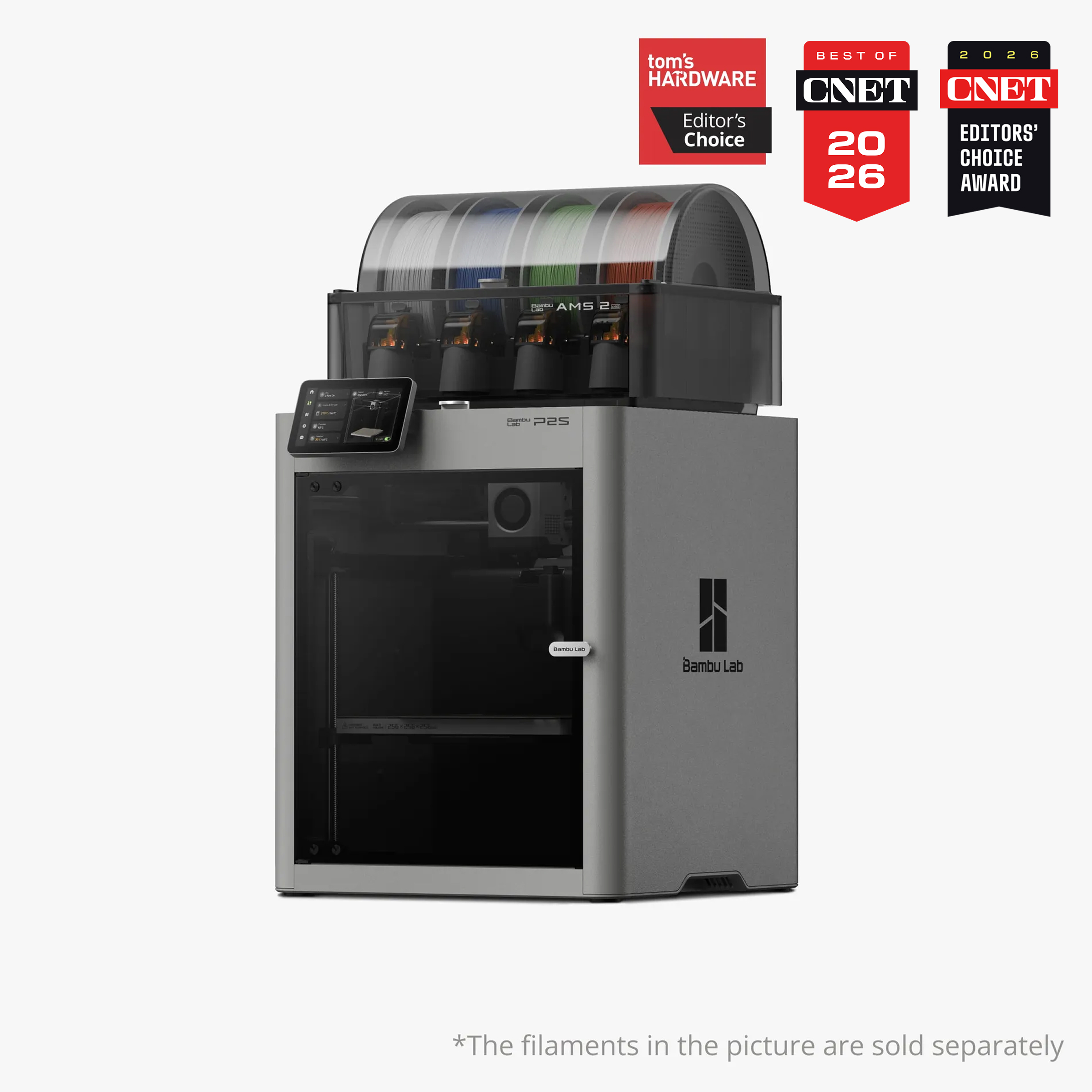
Bambu Lab X2D vs P2S: Which Printer Should You Buy?
Bambu Lab X2D vs P2S: Which Printer Should You Buy?
Bambu Lab's enclosed printer lineup is genuinely confusing right now. The X2D and P2S sit within $150 of each other at their base prices, share the same build volume, support the same materials, and both run in a 65°C heated chamber. On paper they look almost identical.
But underneath the spec sheet they are fundamentally different machines — and choosing the wrong one means either overpaying for a feature you don't need or missing the one capability that would have made your prints significantly better.
Here's the full breakdown.
Price: Base vs Reality
This is where most comparisons go wrong.
- Bambu Lab X2D: $649 base — but the version most people actually want is the Combo with AMS2 Pro at $899
- Bambu Lab P2S: $799
If you're comparing the base X2D ($649) against the P2S ($799), the X2D looks like the obvious deal. But the X2D's standout feature — multi-color printing — requires the AMS2 Pro, which brings the real-world cost to $899. That flips the comparison entirely: the P2S is now $100 cheaper than a fully-equipped X2D.
Neither comparison is wrong. It just depends on what you plan to print.
The Core Difference: Dual Extrusion vs Single Nozzle
This is the real decision. Everything else — speed, enclosure, materials — is nearly identical between these two printers.
Bambu Lab X2D: Dual Extrusion
The X2D uses a dual extrusion system: two independent hotends that can each load a different filament simultaneously. This unlocks something the P2S cannot do: soluble supports.
With a second nozzle loaded with BVOH or PVA filament, the X2D can print complex geometries with supports that dissolve in water. Drop the print in a bucket, wait a few hours, and the supports are gone — leaving behind surfaces you could never achieve with breakaway supports. For mechanical parts with internal channels, overhanging threads, or organic shapes, this is transformative.
Dual extrusion also means true simultaneous two-material printing — not sequential swapping, but both materials laying down in the same layer.
Bambu Lab P2S: Single Nozzle + AMS
The P2S uses a single nozzle and relies on the AMS 2 system for multi-color printing. The AMS purges the previous color before switching — which works excellently for color changes but cannot do what soluble supports require.
The benefit of single nozzle: less waste. Dual extrusion systems generate purge blocks between material switches. The P2S with AMS handles color changes more efficiently, making it better suited for multi-color decorative prints where you want to minimise filament waste.
Speed
This is the one spec where the P2S clearly wins:
| Printer | Max Speed |
|---|---|
| Bambu Lab P2S | 600mm/s |
| Bambu Lab X2D | 500mm/s |
100mm/s doesn't sound dramatic, but it adds up on large prints. If throughput is important — if you're running the printer near-continuously — the P2S gets jobs done faster.
Build Volume
Effectively identical:
| Printer | Build Volume |
|---|---|
| Bambu Lab X2D | 256 × 256 × 260mm |
| Bambu Lab P2S | 256 × 256 × 256mm |
The X2D has 4mm extra height. In practice this won't be a deciding factor.
Materials
Both printers support the same extensive material list: PLA, PLA+, PETG, ABS, ASA, TPU, PA, PA-CF, PC, and PET-CF. The 65°C active heated chamber on both handles everything in that list reliably.
No advantage to either printer here.
LiDAR: X2D Only
The X2D includes Bambu's LiDAR scanning system for first-layer inspection. It scans the bed surface before printing and compensates automatically for surface imperfections. The P2S has auto-leveling but not LiDAR.
In real-world use the difference is subtle — Bambu's standard auto-leveling is already very good — but it's a meaningful quality-of-life feature if you print frequently with demanding materials on different surfaces.
Who Should Buy the X2D?
The X2D at $649 (or $899 Combo) is the right choice if:
- You print functional parts with complex internal geometry that need soluble supports
- You work with two different materials in the same print (flexible + rigid, for example)
- You're upgrading from an X1 Carbon and want a direct successor with the same dual-extrusion workflow
- You primarily print engineering materials like PA-CF, PC, or PET-CF and want LiDAR accuracy
Who Should Buy the P2S?
The P2S at $799 is the right choice if:
- You want multi-color printing without paying the $899 Combo price
- Speed matters — you run the printer hard and 600mm/s makes a real difference
- Your prints are decorative, cosmetic, or don't require soluble supports
- You want a simpler single-nozzle system with less purge waste on color changes
Quick Comparison
| Bambu Lab X2D | Bambu Lab P2S | |
|---|---|---|
| Base price | $649 | $799 |
| Multi-color (with AMS) | $899 | included in P2S Combo |
| Max speed | 500mm/s | 600mm/s |
| Extrusion | Dual nozzle | Single nozzle |
| Soluble supports | ✓ Yes | ✗ No |
| LiDAR | ✓ Yes | ✗ No |
| Heated chamber | 65°C | 65°C |
| Build volume | 256×256×260mm | 256×256×256mm |
| Difficulty | Beginner | Beginner |
The Bottom Line
If soluble supports and dual-material printing are not in your workflow, the P2S is the stronger value. You get a faster printer for $100 less than the X2D Combo, with a simpler system that wastes less filament on multi-color prints.
If you want soluble supports or you specifically need dual extrusion for your projects, the X2D justifies its $899 Combo price — no other Bambu Lab printer offers this capability.
Not sure which fits your setup? Take our printer quiz and get a personalised recommendation based on your budget, experience level, and what you actually plan to print.
FAQ
Is the X2D worth $250 more than the base P2S?
Only if you need what it offers. Soluble supports are genuinely useful for complex functional parts, but most users never need them. If you're printing multi-color decorative objects or straightforward functional parts, the P2S's extra speed and lower price make more sense.
Can the P2S print soluble supports?
No. Soluble supports require a second nozzle to deposit support material simultaneously. The P2S has one nozzle and uses the AMS for filament switching — but the AMS purges and switches sequentially, which cannot replicate true dual extrusion soluble support printing.
Do both printers work with the AMS 2 Pro?
Yes. Both the X2D and P2S are compatible with the AMS 2 Pro for multi-color printing. The X2D Combo ships with AMS2 Pro included at $899. For the P2S, check the Combo configuration which bundles AMS at purchase.
Which is better for ABS and engineering materials?
Equal. Both run a 65°C active heated chamber, both support ABS, ASA, PA, PA-CF, PC, and PET-CF. The X2D has LiDAR for slightly more reliable first-layer detection, but both are excellent choices for engineering filaments.
Is the X2D a replacement for the X1 Carbon?
Yes — the X2D is Bambu Lab's direct successor to the X1 Carbon, carrying forward the dual-extrusion and LiDAR features that made the X1C popular among demanding users.
Not sure which printer to buy?
Take our 2-minute quiz and get a personalised recommendation.
Find my printer →